The Central Board of Indirect Taxes and Customs (CBIC) recently notified the Central Goods and Services Tax (Amendment) Rules, 2024, introducing a significant new facility for taxpayers: FORM GSTR-1A. This new form acts as a crucial bridge between your outward supply statement (GSTR-1) and your monthly return (GSTR-3B), allowing for last-minute corrections and additions.
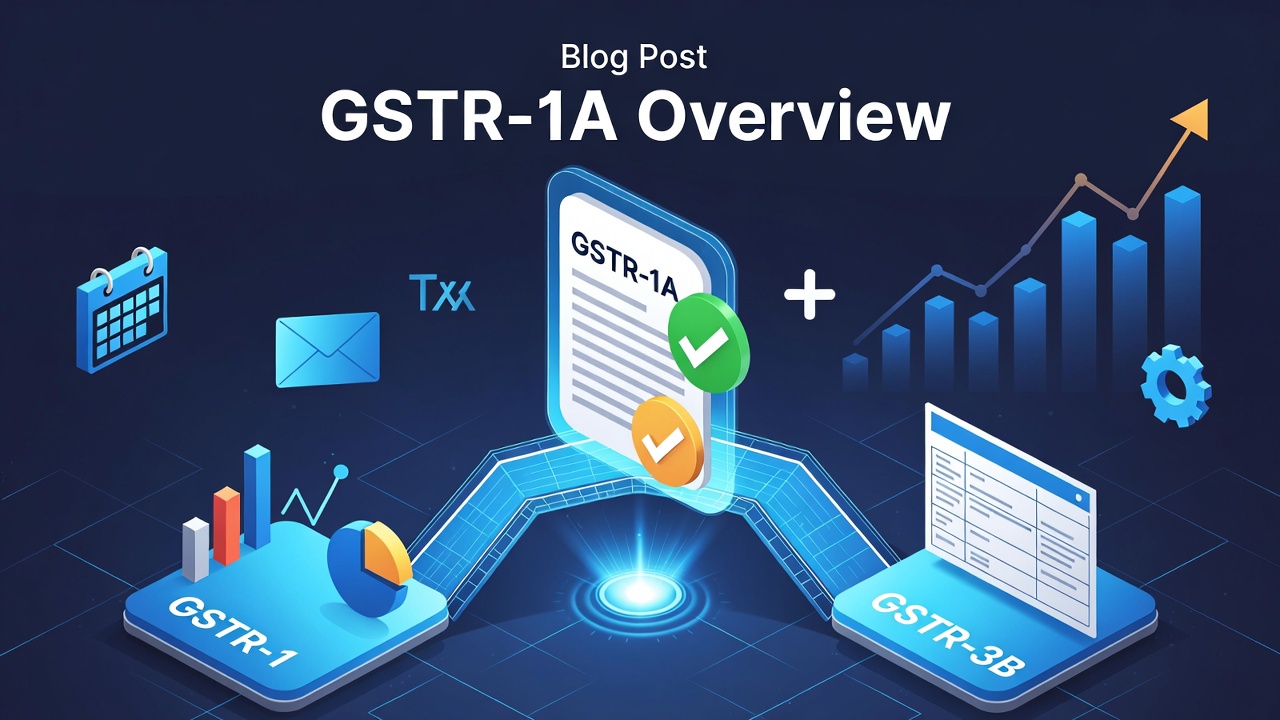
Here is a comprehensive breakdown of what GSTR-1A is and how to use it effectively.
What is GSTR-1A?
GSTR-1A is an optional facility provided to registered taxpayers to add any particulars of the current tax period that were missed in FORM GSTR-1, or to amend particulars already declared in GSTR-1.
Think of it as a "second chance" or an amendment window that opens after you have filed GSTR-1 but before you file GSTR-3B for the same tax period. It ensures that the liability auto-populated in your GSTR-3B is accurate and includes all necessary corrections, saving you from interest liabilities or manual adjustments later.
- Key Feature: It is an optional form and attracts no late fees.
- Availability: It becomes available after the due date or actual filing date of GSTR-1 (whichever is later) and remains open until you file GSTR-3B.
Who Should File It?
You should consider filing GSTR-1A if:
- You missed reporting certain invoices or export details in your GSTR-1.
- You made a mistake in the details (e.g., wrong value) reported in GSTR-1 and need to correct it immediately before paying tax. However, amendment of a document which is related to change of recipient‘s GSTIN shall not be allowed in GSTR-1A.
- You want your recipients to see the correct Input Tax Credit (ITC) in their GSTR-2B. However, the details furnished in GSTR-1A will be populated in the recipient's next available GSTR-2B.
Important points to note:
- Amendment of a document which is related to change of recipient‘s GSTIN shall not be allowed in GSTR-1A.
- The details furnished in GSTR-1A will be populated in the recipient's next available GSTR-2B.
If you have no errors to correct or missing invoices to add after filing GSTR-1, you do not need to file GSTR-1A.
Main Contents of GSTR-1A
The form is divided into sections that mirror GSTR-1 but serves specific purposes:
- Outward Supplies to Registered Persons (B2B): For reporting missed invoices to registered entities.
- Export and Zero-Rated Supplies: For missing export invoices or supplies to SEZs.
- Supplies to Unregistered Persons (B2C): For reporting large inter-state invoices or other consolidated B2C supplies.
- Amendments: For correcting details of invoices, debit/credit notes, or B2C summaries already filed in GSTR-1.
How to Fill Data: Absolute vs. Differential Values
One of the most critical aspects of GSTR-1A is knowing how to enter the data. The input method changes depending on whether you are adding new records or amending existing summaries.
| Table & Description | How to Enter Data | Example |
|---|---|---|
Tables 4A, 4B, 5, 6, 9B (B2B Invoices, Exports, Credit Notes) | Absolute Values (Additions only) Enter the full details of the missed document. Do not use this for amendments. | Scenario: You forgot to report Invoice #101 (Value: ₹50,000) in GSTR-1. Action: Enter the full details of Invoice #101 in Table 4A of GSTR-1A. |
Table 7, 10 (B2C Others - Consolidated) | Conditional Entry Use this only if you are adding a Place of Supply (POS) + Rate combination that was not declared in GSTR-1. If the combination exists, you must use the Amendment Table 10. | Scenario-A: You missed reporting B2C sales to Goa@18%. No entry for Goa@18% exists in your GSTR-1. Action: Add the entry in Table 7. Scenario-B: You reported Goa@18% in GSTR-1 but the value was low. Action: Do not use Table 7. Use Amendment Table 10. |
Tables 9A, 9C (Amendments to Invoices/Notes) | Revised Values Enter the revised details of the document. This replaces the original entry filed in GSTR-1. | Scenario: You reported Invoice #102 as ₹10,000 in GSTR-1, but it should be ₹15,000. Action: In Table 9A, enter the revised value of ₹15,000. |
Table 12 (HSN Summary) | Differential Values (+/-) Enter only the difference resulting from the GSTR-1A additions or amendments. Use a negative sign for reductions. | Scenario-A: You amended an invoice in GSTR-1A, increasing value by ₹5,000. Action: Enter 5,000 in Table 12. Scenario-B: You issued a credit note in GSTR-1A reducing value by ₹2,000. Action: Enter -2,000 in Table 12. |
Impact on Supplier's GSTR-3B (Liability)
The primary goal of GSTR-1A is to ensure your GSTR-3B is accurate.
- Auto-Population: The details declared in GSTR-1 PLUS the details declared/amended in GSTR-1A will be auto-populated into your GSTR-3B.
- Liability Update: If you add sales in GSTR-1A, your tax liability in GSTR-3B will increase automatically. If you reduce values (e.g., via credit notes or negative differential values), your liability in GSTR-3B will decrease.
- ITC for Recipients: Supplies declared in your GSTR-1A will reflect in your recipient's next open GSTR-2B.
Impact on Recipient's GSTR-2B (ITC)
It is crucial to note that filing GSTR-1A does not give your recipient the Input Tax Credit (ITC) in the same month. Supplies declared or amended in GSTR-1A will be made available in the next open GSTR-2B of the recipient.
Scenario: You issue an invoice in January 2025. You miss reporting it in your GSTR-1 filed on 8th Feb.
Correction: You report this missed invoice in GSTR-1A on 15th Feb.
Result: This invoice will not appear in the recipient's January GSTR-2B (generated on 14th Feb). It will instead appear in their February GSTR-2B (generated on 14th March).
Conclusion
GSTR-1A is a welcome relief for taxpayers, reducing the need to wait for the next month to fix errors. By utilizing this facility, businesses can ensure their GSTR-3B matches their books perfectly for the current period, streamlining compliance and reducing friction with recipients over missing ITC.